Tuesday, May 11, 2010

OutRun Easter Egg - The Definite Guide!

For a while it's been known that on some versions of OutRun holding the start button, just before a checkpoint, will reveal a secret message: "PROGRAM YU SUZUKI 1986 SEP".


However, it's also been known that this easter egg does not work on all versions of the game.

Well, that's until now. I've decompiled the code related to this and will list the differences below, including how to enable this easter egg on later revisions of the game.

Sitdown/Upright Revision A: This version works as stated. Just before any checkpoint, hold start (just before the sky is due to cycle to the upcoming level colour) to reveal the message. Easy.

Sitdown/Upright Revision B: Activating the egg on this version is more complex. First you will will need to achieve a high score, and enter "YU." as your name, complete with trailing full-stop.


Furthermore, the easter egg can only be activated when transitioning from Stage 2 to Stage 3 on this version of the game. Yes, they've actually included extra code to handle this.
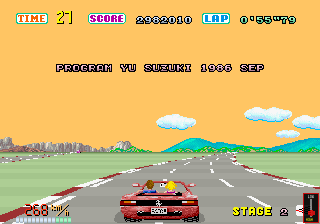


It should also be noted that the egg can only be displayed once and is then deactivated. Also, if the user enters "YU." again on the high score table, the egg will also be deactivated. I'm not certain why this required such a rewrite - it's not as if it allows the user to cheat in the game.

The easter egg code is buried in the middle of a routine to handle setting up the sky palette fade from one level to the next. Which possibly indicates that the programmer wanted to keep the code hidden from more common routines that were shared with the team. I wonder who wrote this piece of code, and why it was heavily altered between revisions?

Aside from that I've completely disassembled the entire service test code - which enabled me to figure out a bunch of minor book keeeping information. I've also disassembled the palette changing code that handles the road, ground and sky when transitioning between levels. I've even disassembled some rather dull code relating to the coin chutes. Next - there's a load of tilemap code to be looked at. The quest continues!

Saturday, May 01, 2010

Service Test

I'm debugging the service test code at the moment. After some of the recent decompilation work, I fancied something easy.  Nevertheless there are still some cool things to be discovered.

One thing you'll notice in MAME, is that the "Motor Test" fails:


The motor test, which only runs if the DIP switches are set to the Moving cabinet type, essentially moves the cabinet from left to right. The limit switches activate at the extremities and the pot values from the motor are recorded. A magnet also detects the centre position.  

I quickly hooked up a simulation of the motor hardware in the Jemu2 driver I coded, using knowledge from the decompilation. Here are the results:

Notice that there are no error messages, and the values are correctly recorded. 

As far as I can see register 0x140001 works as follows:

Bit 3 = Set to indicate left limit reached
Bit 4 = Set to indicate centre reached
Bit 5 = Set to indicate right limit reached

The desired motor position is written to register 0x140003.

The actual motor position can by read by writing '12' to the analogue select register 0x140012.

Wednesday, April 14, 2010

Finally, my gold plated Ferrari is here!

In my unending quest to fill my house with OutRun related junk, I picked up the following Sega OutRun branded gold Ferrari:


The seller had this to say, I've no idea how accurate this information is with regard to the number produced:

Rare Sega "Out Run" Commemorative Ferrari 1986
Custom cast, gold plated, all metal scale model Ferrari Testerossa
Approx. 4 3/4" long x 1 1/8" high and weighs about 1.5lb
Fewer than 100 were produced and presented to the top tier arcade game distributors.
The model's exterior rear view mirrors while no longer attached, can be easily re-mounted and are included with the purchase

The only other information I can find this, and in fact the only other mention of it I've come across is on the following webpage

The only information I know about it is that it was given out by Sega, apparently as part of a trophy to retailers who sold copies of Outrun. The back of the car, right behind the rear window, "OutRun" is engraved in it, and the license plate says "Sega". The bottom also has a nut on it, which is a definite indication that it is the top piece to some kind of trophy. After I bought it 8 years ago, I have never been able to find any other information on it since.

Intrigued, I asked for a bit more information and it seems they were samples for an advertising promotion:

They were salesman samples so they are quite rare, They were made to show Sega some of the advertising possibilities they could choose from and I got them directly from the salesman who had them made. He tells me they were never displayed, only passed around by top executives at Sega.


A gold plated Golden Axe branded axe was also thrown in with the bundle.

Does anyone else own one of these? And does anyone know whether it was in fact part of a trophy?

Monday, April 12, 2010

Progress Update

Quick update on what I've been upto over the past week. I've decompiled and commented the following code:

- Palette setup for ground colour, road colours etc.
- Palette setup for sky shading effect
- Code to convert internal increment value to user friendly KP/H display. Including tile blitting.
- Code to setup the speed at which to scroll the sprites. This is independent from the road scrolling. 
- Code to adjust x position of the car based on the curvature of the road, to ensure car 'sticks' to the road on curves.
- Code to convert steering value from hardware to a meaningful change in x position
- Code to prevent car from straying too far from the boundaries of the road.

There is still a LOT of code to go. This is a long slog!

OutRun Version Differences

Here are some details of the visual differences between  the first revision of the OutRun ROMs (deluxe sitdown) and the final revision (sitdown/upright, Rev B).
Notice the omission of "Select Music By Steering" on the original version:


Stage 1, Coconut Beach, has a different track layout. 
Notice the absence of scenery on the right hand side, and in the central reservation.
The dual lanes at the start of the track also merge more quickly into a single road on this version.


Notice the strange positioning of the Flamingo huts on the right hand side of the road. These are replaced with palm trees on the later revision.

 
The well documented course map differences. Older revision shown top. I presume the levels were reordered, so that the more visually impressive levels were shown earlier in the game.


Service Test. Lack of Backup Ram clearing.
Memory Test. Deluxe Sitdown and later revisions.

Can anyone find any more? Once I complete the disassembly of OutRun, then it will be easier to compare the revisions to find out what other subtle, non-visual, changes were made.

Thursday, April 08, 2010

Code Reuse At Sega

Out of curiosity, and to follow up a previous post, I examined some of the Super Hang-On code to figure out the level of code reuse between the games as they share the same hardware. A quick glance at the code shows that a lot of the core routines, responsible for generating the road detailed in this post are identical. It appears that the slave CPU code to handle road splits is removed from Super Hang-On.


It's probably not a surprise, given that there are other obvious similarities between the titles, including some of the sampled sounds being identical.

Now the OutRun hardware supports two road layers. But as far as I know, Super Hang-On only uses a single road layer. Interestingly, there was a conversion of Super Hang-On to the Space Harrier hardware, which only supports a single road layer. Presumably, OutRun wasn't converted in the same manner, because of its reliance on two road layers for the wider roads (even when two distinct roads aren't displayed, the two road layers are sometimes in use).

One other example of code reuse I've found is between OutRun and Sonic the Hedgehog 2 on the Megadrive. Both games share the same random number generator, right down to the default random seed that's used.

Wednesday, April 07, 2010

OutRun Yu Suzuki Interview

Back in 2008, RetroGamer magazine ran an interview with Yu Suzuki discussing the development of OutRun.

The article can be read online here.


It's interesting to read about the features that didn't make it into the final game: 

“Because of budget and development time limitations, some of the contents I’d planned had to be squeezed or cut. I’d made preparations for eight individual characters and I wanted to include various events at each checkpoint, which would have made the player experience a story; something like the Cannonball Run film. I also wanted to give players a choice of supercars to drive, so that they could enjoy differences in car performance.”

Personally, I'm pleased the checkpoint events didn't make it, as they'd have potentially spoilt the flow of the gameplay. The changeable characters make sense, as the player sprites are drawn separately from the car sprite and have a table of offset co-ordinates. This also allows the car sprite to be horizontally flipped (it wouldn't look good if the players swapped seats, as per the Amiga port). There's no mention of the dual direction traffic that I uncovered in the game code though... :)

In other news, I've returned to working on the Master CPU decompilation at the moment. There's still a heck of a lot of code to plough through, but it's relatively trivial compared with the previous Slave CPU work.

One subtlety that I noticed whilst working on the code is that the position of the shadows in the game change dependent on which direction the car is facing (in practical terms it's set by the x position of the tilemap backdrop). This attention to detail is somewhat outstanding - I'd never even noticed this previously...