Showing posts with label power drift. Show all posts

Tuesday, October 01, 2019

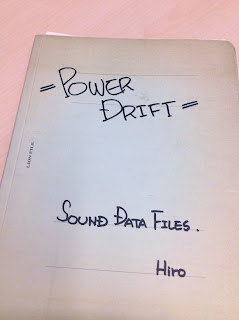
Raiding Hiro's Sega Audio Archives

In recent years, Sega consolidated its scattered Tokyo offices to a centralised building in Ousaki. One office that closed at the start of 2019 was the Otorii office. This office had been the key development hub since September 1985, shortly after Hang-On development concluded. As such, intriguing development materials were unearthed in the process.

Sega Otorii Office Building

Hiro posted a vast collection of audio planning documents and media from 1985 through to the early 1990s. When Hiro joined Sega in 1984, music was composed on hand-written sheets.


Space Harrier Sheet Music. Note that game was called 'Heli' at this stage, as the fantasy theme had not yet been adopted.

Synthesizers used to compose the melodies included the Yamaha DX-7 for Space Harrier and the Yamaha PSR-70 for AfterBurner. The sheet music was manually transcribed into Macro Music Language for the audio engine to process. This took the format of the note, followed by its length (e.g. C-4, L4, A#4, L8). Once assembled, the actual audio could be tested on hardware. Needless to say this would have been a time consuming process.

Hiro's ROM cartridges for the Yamaha DX-7 Synthesizer

For the arcade games of this era, sound comprised lo-fi 8-bit samples used for voices, drums and sound effects. The samples were paired with a YM sound source (typically a Yamaha YM2203 or YM2151 chip), mostly used for melodies. YM sounds could be created and edited with an audio editor, which ensured each game had its own style, despite sharing audio hardware. For example, AfterBurner's 'Final Take Off' uses the YM to drive the melodies, but the overlaid guitars are in fact samples.

Data was saved to 8 inch floppy disks.

The following labels read 'OutRun 2' in reference to the revision of the music, as opposed to being anything to do with OutRun's sequel. I wonder if the earlier revisions of the OutRun music still exist?


OutRun's 'Passing Breeze' was initially named 'Passing Wind', until someone pointed out the flatulence reference. So the disk below must date from the end of the development process!


AfterBurner was aptly referred to as 'Top Gun' during development, and the final audio program code appears to have been named TG.HEX. Some of the disks are dated 9th September 1987. 


It appears that data was transferred over the years between 8 inch floppy, through to 5.25 and 3.5 inch floppy for preservation. 


Here we can see the list of commands Power Drift's main 68k program code needed to send to the Z80 Sub program in order to trigger the relevant sound. 


The final Power Drift master. Later on Digital Audio Tapes (DAT) replaced reel-to-reel recordings. 


Sunday, December 17, 2017

2 x Power Drift PCB Repairs

I'd accumulated 4 broken or untested Power Drift PCBs. All four completely black-screened and showed no signs of life. I decided it was time to try to get at least one of them working. They are difficult boards to find working and I've always fancied playing the game in my OutRun cab.

Board 1 (The Easier Repair)

The Y-Board is complicated, using 3 68k processors, a z80 for sound and loads of custom chips. So when faced with a dead board, there are a lot of potential candidates. Using the scope, I could see the main 68K CPU was resetting every few seconds. There seemed to be good activity on the data and address lines however.

I tested the Main CPU EPROMs first and they all seemed to be bad?! To be honest, I don't know how much I trust the GQ-4X with 27C1000 EPROMs.... it seems inconsistent. But anyway, all the NEC D27C1000 branded ones failed romident. I programmed some new ones, and pinched a few others from one of the other spare PCBs.

The board then booted into life, but with lots of graphical corruption. Amazing - I've never had such an easy fix before. However, the game completely crashed after a short period of time.

Using the scope again I could see that the 'Sub X' CPU (Mame driver naming) had no activity on the data or address bus. The 'Sub Y' CPU seemed to be behaving sensibly. At this point I replaced ALL the NEC branding EPROMs for both CPUs.

The game then ran consistently without crashing, however there were occasional graphical errors.

I swapped the lower video PCB out with one of the other spares and this solved the remaining graphical issues. Unfortunately it was quite late at this point and I forgot to take photos of my progress.

So there you go - not really the most technical fix-log ever. But a fix is a fix, and I'll have a poke around the remaining 2 PCBs next. I also need to hook up some controls.


Board 2

Now that I had a fully working boardset from the previous repair it was easy to establish that I had 3 broken CPU boards and 3 partially working video boards with graphical errors remaining.

Picture shows the CPU board (courtesy of arcade.ym2149.com)


The CPU Board contains 3 x 68000 processors. These and known as the main CPU, X CPU and Y CPU. I initially investigated the main CPU signals and bus with my scope. I verified the EPROMs, then checked the SRAMs and buffer logic chips to ensure they were doing something sane. The PCB itself was filthy. Amusingly, pretty much every EPROM I pulled had a dead spider under it. One of them actually made me jump as it flew out at me with the chip! I was finding physical bugs, but no technical bugs, so it was time to move on!


I moved onto the X CPU. After working my way around the chips in the circuit I found little activity on the SRAM data and address lines. I piggybacked the first pair of SRAMs at IC 84 and IC 85, and to my delight the board booted. At this stage there were no zoomed sprites at all and lots of graphical errors. Only some of the static 2D sprites displayed correctly. However, I could coin up and hear sound and music which proved  the main 68000 circuit and Z80 sound circuit were healthy.


I put the board into test mode. Things weren't completely readable but the screen could at least be compared with MAME. The tests reported 4 SRAMs and 2 EPROMs were bad in the X CPU circuit. However, this report couldn't be fully trusted at this stage due to the piggybacked RAMs. I tested the EPROMs that were reported bad and found them to fine to prove this point.


I socked two replacement 6164 SRAMs at IC 84 and IC 85.


 I tested the old ones out of circuit and found them both to be faulty.


I booted the board again to verify the replacements were working. I then decided to piggyback the remaining two SRAMs that were also reported faulty by the internal tests at IC 82 and IC 83. They were right next to the previous bad ones and also similar Toshibas, so could in theory be bad as well. At this point I managed to see glimpses of the zoomed and rotated sprites that make up the game's road layer and backgrounds. The rotating Power Drift logo also showed signs of working.


After replacing IC 82 and IC 83, the game was running with scaled sprites.


The self-test now reported that everything was ok, including the video board SRAMs it had previously declared bad.


However, the game wasn't running correctly yet. At this point I swapped in the other video boards I had available to find the least broken candidate. This also proved that the CPU board was 100% worked and the remaining errors were on the lower video board.

This was all well and good, but I had no easy way of accessing the lower video PCB. This is where a set of interconnects built by UKVAC's ColinD came in handy. I'd had these sat in a box for months, but never had the need to construct them. I soldered them together, and could now separate the PCBs whilst powered up.


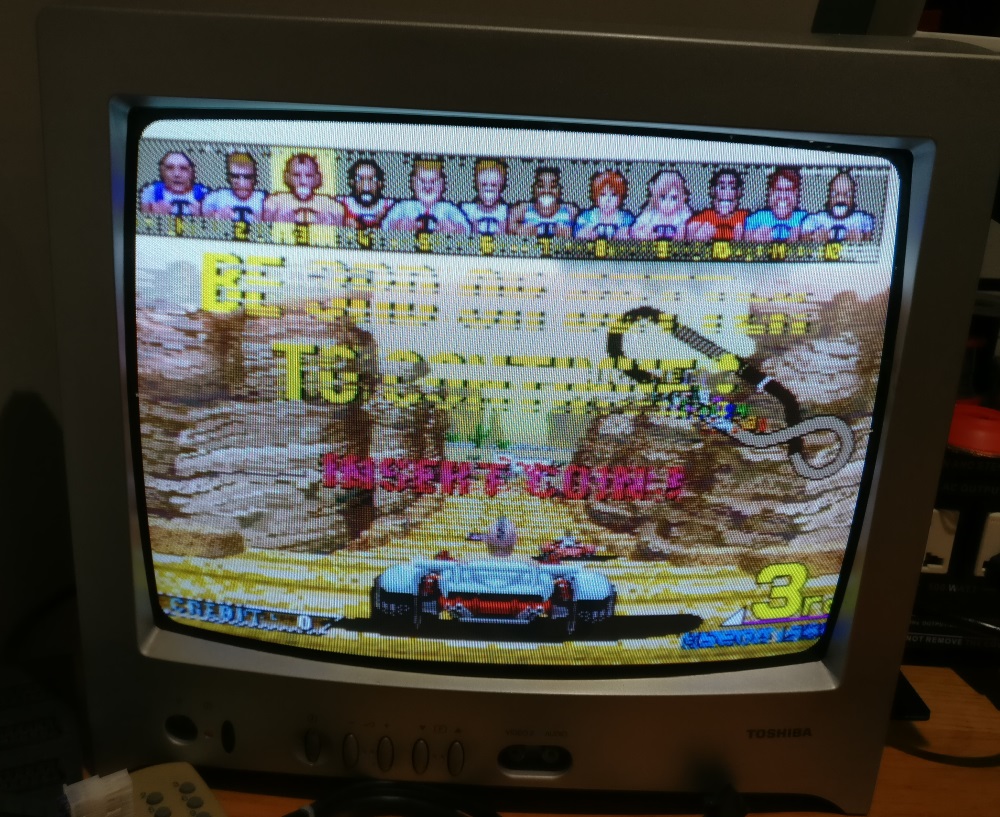
Now here's where things got quirky. The video boards all exhibited problems with the 2D static HUD sprites. For example, the "BE 3RD OR BETTER TO CONTINUE" graphic had jailbars. This would often be the sign of a bad line on an EPROM, SRAM or logic chip. I knew the SRAMs were good from the on-board tests so I turned to the EPROMs which weren't tested by the on-board routines.


Using my Sega Sprite Viewer tool, I could tell that these graphics were located in two interleaved EPROMs: epr-11789 at IC 16 and epr-11791 at IC 14.


As a first check I verified the EPROMs out of circuit. I had a little trouble reading them, but eventually got a good read. I put this down to the GQ-4X being a little quirky with 27C1000 EPROMs. I've had trouble in the past with them despite using the recommended jumper wire.

However, I was now really stumped as to what the problem was. I swapped in two EPROMs from another broken video board and got a different visual problem in the same area. I swapped another set in from a different video board and got yet another different problem with the graphics!!

I was really pulling my hair out and spent quite a lot of time checking various stuff. As a last resort, I programmed a new EPROM.


And what do you know... Isn't that unbelievable that EVERY video board had the same damaged EPROM? Maybe there's something about the board's construction that causes this.


Next step will be to verify the controls. I'll do this once the following PCB arrives from Alex that allows you to connect a PS2 controller on the bench for testing and a lot of other nifty stuff. But we'll cover that another time! I may have a (short) break from fixing Power Drift boards for now.


Monday, November 12, 2012

Power Drift Easter Egg

Ding Ding Round Two! This time, we're pulling Power Drift apart. A crazy game, with some amusing secret messages, that I don't think have ever been revealed.... After 20 years, it's surely time to see what the developers were smoking.


As I realised during my OutRun work, AM2's titles contain weird and wonderful content. Power Drift it no exception, and I soon found text about elephants and various smells by examining the memory in MAME.


Then it was a case of tracing through tons of code to figure out how it was used. To complicate matters, there was a nasty red herring. If you enter SEX on the high-score table, you will see the message DANGER DANGER!


I thought I'd solved the puzzle, as searching for the string 'SEX' in memory revealed the following location:


You'll notice that the first three characters spell SEX, followed by various other letters. I recognised some of these initials as belonging to the AM2 development team, so I presumed entering the other names would invoke the other messages. Unfortunately, this wasn't quite correct. The fragment of code I'd uncovered that used the above table didn't seem to be called when I entered a name. 

Instead, I found a manual check against 'SEX' hard coded elsewhere. Here is some of my commented disassembly: 


What was going on? By examining the code, I realised that if you held BRAKE and pressed START when entering a special name, a separate function would execute. Bingo, this was the section that read the larger initial table. And now, we can display messages regarding elephants written in somewhat dubious English:


Not only that, but for each special name entered, you generally receive a different message dependent on which gear you are in. Here are some others, that amused me:


Well, finding other messages becomes easier when you've decompiled the code. A summary of the messages follows :)

When Brake & Start Button Depressed:
SEX: DANGER !! DANGER !!

When Brake & Start Button Pressed (Select one of two messages with gear):
SEX:  LAKE YOU ? ME TOO ! & MACHINE T.K.G.!!
KEY: I LOVE MAKIKO. & I LOVE CYNDI.
TKG:  I LOVE RAY CHAN. & I LOVE RIE CHAN.
GAK: SAKICHI !! KITARO !! & I LOVE CHISAKI !
OKA: I AM TALLER THAN T.K.G. ! & KIM SAN ISSHOU TUITE IKIMASU.
REE: HALLO !! LETS FIND ANOTHER MESSAGES. & ARE YOU M2C2 MENBER?
NAK: NIGASITA SAKANA WA DECOI.
AKI: LUCY IS MINE! & EMILY IS MINE!
MAT: DO YOU KNOW ELEPHANT SMELL??
SAD: I LOVE KAYURI CHINA & NS400 IS FARSTEST BIKE IN THE WORLD.
HIR: MUSIC DESIGN BY HIRO. & SOUND DESIGN BY MY DESHI.